
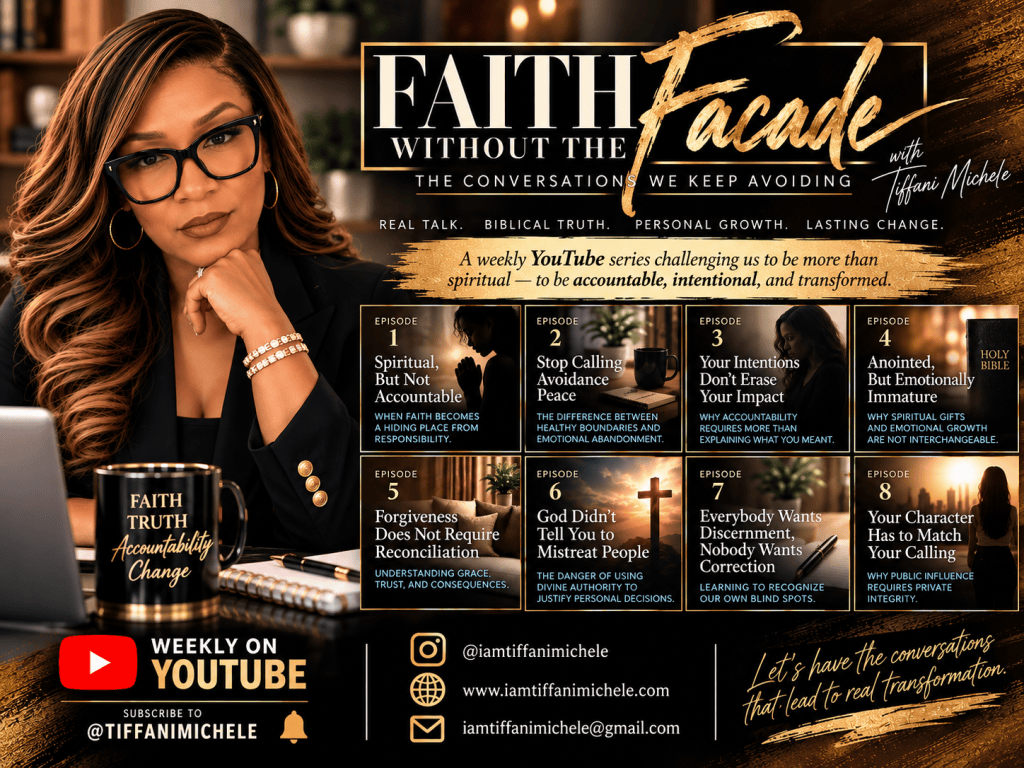
Faith Without the Facade — Episode 4: The Conversations We Keep Avoiding
By Tiffani Michele

“Your gift may demonstrate what you’re capable of doing, but your character reveals who you’re becoming.”
Can we have another uncomfortable conversation?
Because there’s something I’ve observed over the years that I believe deserves serious attention, particularly within our faith communities.
We have become exceptionally skilled at recognizing people’s gifts.
We celebrate the preacher who can command a room.
We admire the worship leader whose voice moves us to tears.
We applaud the ministry leader who inspires hundreds, sometimes thousands, of people.
We recognize charisma, influence, eloquence, and the ability to communicate spiritual truths with extraordinary conviction.
And there’s nothing inherently wrong with celebrating those abilities.
But here’s where I believe we need to be careful.
Somewhere along the way, we’ve started treating spiritual giftedness as evidence of emotional and spiritual maturity.
And those are not necessarily the same thing.
You can possess remarkable abilities while still struggling to communicate respectfully.
You can inspire people publicly while having difficulty accepting correction privately.
You can speak eloquently about forgiveness while refusing to acknowledge the people you’ve hurt.
And you can genuinely love God while still having significant areas of your emotional life that require attention, healing, and growth.
Now, before someone interprets this as an attack on spiritual leaders or gifted individuals, let me establish something.
This conversation isn’t about questioning anyone’s calling.
It’s not about dismissing the importance of spiritual gifts.
And it’s certainly not about expecting perfection from people who serve in ministry.
It’s about recognizing that the development of our gifts should never become a substitute for the development of our character.
Welcome to Episode 4 of Faith Without the Facade: The Conversations We Keep Avoiding.
Let’s get into it.
The Difference Between Being Gifted and Being Mature
One of the most important distinctions we can make is understanding that talent, spiritual gifts, emotional maturity, and character development are related but separate dimensions of a person’s life.
A person may be an exceptional communicator.
They may possess remarkable leadership abilities.
They may demonstrate a deep understanding of Scripture.
They may have an extraordinary ability to encourage, inspire, teach, or minister to others.
But none of those abilities automatically guarantees that the individual has developed healthy emotional habits.
Why?
Because emotional maturity requires intentional development.
It involves recognizing and managing our emotions, understanding the perspectives of others, responding constructively to conflict, accepting responsibility, and maintaining appropriate boundaries.
Those skills don’t automatically appear because someone receives a title, develops a talent, or gains influence.
They must be cultivated.
Think about a gifted leader who can motivate an entire organization but becomes defensive whenever someone offers constructive criticism.
Or a talented musician who moves audiences through worship but struggles to communicate respectfully when frustrated.
Or someone who consistently offers spiritual guidance to others but refuses to acknowledge their own relational mistakes.
These examples don’t necessarily mean the individuals are insincere in their faith.
But they do reveal an important truth.
Being effective in one area of life does not automatically mean we’re mature in every area of life.
And that’s something all of us, regardless of our gifts or responsibilities, need to understand.
We’ve Celebrated the Gifts, But Have We Examined the Fruit?
Galatians 5:22–23 describes the fruit of the Spirit.
Love.
Joy.
Peace.
Patience.
Kindness.
Goodness.
Faithfulness.
Gentleness.
Self-control.
Consider those qualities for a moment.
They don’t describe how many people follow us.
They don’t describe our ability to command attention.
They don’t measure the size of our platforms, the strength of our voices, or the popularity of our ministries.
They describe qualities of character that should increasingly influence how we live and interact with others.
And that distinction matters.
Because we can become so impressed by what someone does publicly that we overlook how they conduct themselves privately.
We may celebrate a powerful sermon without examining whether the person delivering it practices humility.
We may admire someone’s leadership while ignoring patterns of intimidation or disrespect.
We may become so captivated by someone’s spiritual language that we overlook the absence of compassion in their relationships.
But here’s a question worth asking:
Are we more impressed by the manifestation of someone’s gift than the evidence of their character?
And before we begin evaluating everyone else, let’s turn that question inward.
Are we more concerned with being recognized for what we do than being accountable for how we live?
Because the fruit of the Spirit challenges us to examine our behavior, not merely our abilities.
When Spiritual Authority Becomes an Excuse for Avoiding Accountability
Now, this is where the conversation becomes especially serious.
Spiritual influence carries responsibility.
When people trust someone to provide spiritual guidance, leadership, or encouragement, they often place significant confidence in that individual’s judgment and integrity.
That trust should never be taken lightly.
But what happens when someone begins to believe their position places them beyond correction?
What happens when legitimate concerns are dismissed as disrespect?
When questions are interpreted as rebellion?
When accountability is framed as an attack on someone’s calling?
Those patterns can create unhealthy environments where people become afraid to speak honestly.
And when people feel they cannot question harmful behavior without being accused of spiritual disloyalty, accountability begins to disappear.
Spiritual authority should never become a shield against personal responsibility.
A title does not eliminate the need for humility.
Influence does not remove the responsibility to communicate respectfully.
And being recognized as spiritually gifted does not give someone permission to mistreat the people they are called to serve.
In fact, leadership should deepen our commitment to integrity.
The more influence we have, the more important it becomes to examine how our decisions affect others.
This applies to pastors, ministry leaders, educators, executives, parents, mentors, and anyone entrusted with responsibility for other people.
Leadership is not merely about the ability to direct others.
It’s also about the willingness to govern ourselves.
Emotional Immaturity Doesn’t Always Look the Way We Expect
When people hear the phrase “emotionally immature,” they may immediately imagine someone who throws tantrums, behaves irresponsibly, or struggles to control their temper.
But emotional immaturity can be much more subtle.
Sometimes it looks like someone who cannot accept being wrong.
Sometimes it appears as an inability to apologize without offering excuses.
Sometimes it manifests through passive-aggressive communication, withdrawal, blame-shifting, or an excessive need to control how others perceive us.
And sometimes it looks like someone who is highly accomplished, respected, and articulate but becomes emotionally overwhelmed whenever their behavior is questioned.
Let’s be clear.
Experiencing strong emotions does not make someone emotionally immature.
Neither does struggling with anxiety, grief, trauma, or other emotional challenges.
Emotional maturity is not the absence of difficult feelings.
It’s our developing capacity to recognize those feelings and respond to them responsibly.
A mature person can experience anger without using it as permission to be cruel.
They can feel embarrassed without retaliating against someone who corrected them.
They can need space without intentionally using silence to punish others.
And they can acknowledge that someone else’s perspective may contain truth even when that truth is uncomfortable.
These are learned capacities.
They require self-awareness, practice, and sometimes professional support.
And there should be no shame in recognizing that we need help developing them.
Your Calling Does Not Eliminate Your Need for Healing
Here’s something I believe deserves more attention within Christian communities.
Being spiritually committed does not mean you have no emotional wounds to address.
You can have a sincere relationship with God and still carry unresolved grief.
You can serve faithfully while struggling with communication patterns learned during difficult seasons of life.
You can possess remarkable spiritual insight while needing support to navigate conflict, relationships, or emotional regulation.
And you can be deeply committed to your calling while recognizing that certain experiences have shaped how you respond to criticism, disappointment, or rejection.
None of that automatically disqualifies you from being a person of faith.
It makes you human.
But here’s where responsibility enters the conversation.
Recognizing our emotional wounds should motivate us toward healing rather than become a permanent excuse for behavior that harms others.
Sometimes that healing involves prayer.
Sometimes it involves wise counsel.
Sometimes it involves therapy, mentorship, education, or developing healthier communication skills.
And sometimes it requires the humility to admit that we’ve been trying to lead others through areas of life we haven’t fully learned to navigate ourselves.
Seeking help doesn’t diminish your spiritual authority. It can demonstrate your commitment to stewarding your responsibilities more wisely.
We should stop treating emotional development as though it competes with spiritual growth.
The two can strengthen one another.
Love Is More Than Something We Preach
One of the most challenging passages in Scripture appears in 1 Corinthians 13.
Paul emphasizes the importance of love even in the presence of extraordinary spiritual abilities.
The message is profound.
Spiritual expression without love is incomplete.
And that should challenge us.
Because it’s possible to become so focused on demonstrating what we know about God that we overlook how we treat the people God has placed in our lives.
We can speak about compassion while behaving dismissively.
We can preach patience while responding harshly to inconvenience.
We can teach forgiveness while refusing to acknowledge our own mistakes.
And we can celebrate unity while creating division through pride and an unwillingness to listen.
But love is not simply a concept we discuss.
It’s something we practice.
It’s reflected in how we respond when someone disagrees with us.
It’s revealed in how we treat people who cannot offer us anything in return.
And it’s demonstrated through our willingness to recognize the dignity and humanity of others.
If our spirituality never challenges how we treat people, we need to examine what kind of transformation we’re actually pursuing.
The Danger of Confusing Charisma With Character
As someone who has spent years working in leadership, education, coaching, and creative environments, I’ve seen how easily people can be drawn to individuals who possess extraordinary charisma.
Charismatic people often know how to connect with audiences.
They can communicate ideas with passion.
They can motivate people to believe in a vision.
They can inspire action and generate enthusiasm.
Those abilities can be valuable.
But charisma is not the same as character.
A person can be exceptionally persuasive without being consistently trustworthy.
They can be admired without being accountable.
They can attract followers without developing the emotional discipline necessary to lead responsibly.
And this is why we must become more intentional about the qualities we celebrate.
Do we value humility as much as confidence?
Do we value integrity as much as influence?
Do we value consistency as much as charisma?
Do we celebrate the person who quietly keeps their commitments as enthusiastically as the person who delivers an extraordinary speech?
Because the people who make the greatest difference in our lives are not always those who command the largest audiences.
Sometimes they’re the people who consistently demonstrate patience, compassion, reliability, and integrity when nobody is watching.
Character is often revealed most clearly when there is no audience to impress.
Correction Is Not the Enemy of Your Calling
One of the most revealing indicators of maturity is how we respond when someone challenges us.
Now, not every criticism is accurate.
Not every opinion deserves equal weight.
And not every person offering correction is doing so with wisdom or good intentions.
Discernment matters.
But when we automatically interpret every challenge as an attack, we may close ourselves off from opportunities to grow.
Proverbs 15:31–32 emphasizes the value of listening to correction and gaining understanding.
That’s worth reflecting on.
Because correction can reveal things we cannot see about ourselves.
A trusted colleague may recognize a leadership habit that undermines team morale.
A loved one may identify a communication pattern that creates unnecessary conflict.
A mentor may challenge an assumption that has limited our growth.
And sometimes the people closest to us can see inconsistencies between our stated values and our actual behavior.
Receiving correction doesn’t require us to accept every accusation.
It requires us to remain open to examining the truth.
You can disagree with someone’s assessment while still being willing to evaluate your conduct.
And sometimes the most mature response is simply:
“I hadn’t considered that.”
“Help me understand your perspective.”
“I can see where I could have handled that differently.”
Those statements don’t diminish our authority.
They demonstrate humility.
The Mirror Moment: Five Questions About Gifts, Character, and Growth
Before you begin thinking about the pastor, leader, friend, or family member who needs this article, I want you to examine yourself.
Because this series is not about creating a platform for criticizing other people.
It’s about encouraging each of us to take responsibility for our own transformation.
1. Am I more committed to developing my gifts than developing my character?
Do I invest as much time in becoming emotionally healthy, dependable, and compassionate as I do in improving my talents and professional abilities?
2. How do I respond when someone challenges my behavior?
Can I receive constructive feedback without immediately becoming defensive, dismissive, or combative?
3. Do the people closest to me experience the values I publicly proclaim?
Am I demonstrating patience, kindness, integrity, and compassion in my private relationships?
4. Have I used my accomplishments or spiritual identity to avoid acknowledging personal shortcomings?
Do I assume that because I’m successful, influential, or spiritually knowledgeable, I must also be emotionally mature?
5. Am I willing to seek support in the areas where I still need growth?
Can I acknowledge that prayer, mentorship, counseling, education, and intentional self-reflection may all have a role in my development?
These questions aren’t intended to create shame.
They’re designed to create awareness.
Because genuine growth begins when we’re willing to examine the parts of ourselves that don’t receive public applause.
Five Practical Ways to Develop Character Alongside Your Gifts
Recognizing the importance of character is only the beginning.
Transformation requires intentional action.
1. Develop a consistent practice of self-reflection.
Take time to examine how you responded to difficult situations. Ask whether your words and decisions reflected your values, especially when you felt challenged.
2. Invite feedback from people who will tell you the truth.
Build relationships with individuals who care enough to challenge you respectfully. Avoid surrounding yourself exclusively with people who affirm everything you do.
3. Strengthen your emotional communication skills.
Learn to express frustration, disappointment, and disagreement without resorting to personal attacks, manipulation, or unnecessary withdrawal.
4. Seek support when patterns become difficult to change.
Recognize when counseling, mentorship, or other professional resources could help you develop healthier responses. Seeking support is an investment in your growth.
5. Measure maturity by consistency, not visibility.
Don’t evaluate your progress solely by public recognition, accomplishments, or influence. Consider whether the people who interact with you regularly experience greater honesty, compassion, reliability, and respect.
These practices won’t make us perfect.
But they can help us become more intentional about the relationship between what we believe, what we demonstrate, and who we’re becoming.
A Final Thought: Don’t Let Your Gift Outgrow Your Character
I want to leave you with something that I hope stays with you.
We live in a world that often encourages us to become more visible.
More influential.
More accomplished.
More recognized.
And there is nothing inherently wrong with pursuing excellence, developing our gifts, or embracing opportunities to serve.
But what happens when our influence grows faster than our emotional maturity?
What happens when our platforms expand while our willingness to receive correction diminishes?
What happens when we become so accustomed to being admired that we forget how to remain accountable?
Those are questions worth asking.
Because gifts can create opportunities.
Talent can attract attention.
Charisma can inspire people.
But none of those things automatically guarantees integrity.
And none of them eliminates the responsibility to treat people with dignity, compassion, and respect.
The goal should never be to become so gifted that nobody can question us.
The goal should be to become so committed to growth that we’re willing to examine ourselves even when nobody is requiring us to.
So before you ask God to increase your influence, consider whether you’re also developing the character necessary to steward it.
Before you pursue another title, ask whether you’re cultivating the humility to lead responsibly.
And before you celebrate how powerfully you can minister to others, consider how consistently you demonstrate love to the people who experience you outside the spotlight.
Because spiritual maturity is not measured by the absence of mistakes.
It’s reflected in our willingness to recognize those mistakes, take responsibility, and pursue meaningful change.
You can be gifted and still need growth.
You can be influential and still need correction.
You can be spiritually committed and still need emotional healing.
And you can be anointed while recognizing that God is still working on your character.
That’s not a contradiction.
That’s part of the ongoing process of becoming.
Your gift may demonstrate what you’re capable of doing, but your character reveals who you’re becoming.
And that, my friends, is a conversation worth having.
With faith, purpose, and an unwavering commitment to growth,
Tiffani Michele
Faith Without the Facade: The Conversations We Keep Avoiding
Faith should do more than inspire us. IT SHOULD CHANGE US!
Watch Episode 4 on YouTube
Anointed, But Emotionally Immature
Join me for Episode 4 of Faith Without the Facade, scheduled for Saturday, November 14, 2026.
▶️ Watch and subscribe: https://www.youtube.com/@tiffanimichele
This week’s conversation question:
Why do you think we sometimes celebrate people’s spiritual gifts while overlooking the importance of their emotional maturity and character?
Let’s have a thoughtful conversation about faith, responsibility, leadership, and the ongoing process of becoming better.
Connect with Tiffani Michele
Website: www.iamtiffanimichele.com
Instagram: @iamtiffanimichele
YouTube: https://www.youtube.com/@tiffanimichele
Email: iamtiffanimichele@gmail.com








































Leave a Reply