
Faith Without the Facade — Episode 5: The Conversations We Keep Avoiding
By Tiffani Michele
“Forgiveness releases the offense. Reconciliation requires rebuilding trust. And those are not the same thing.”
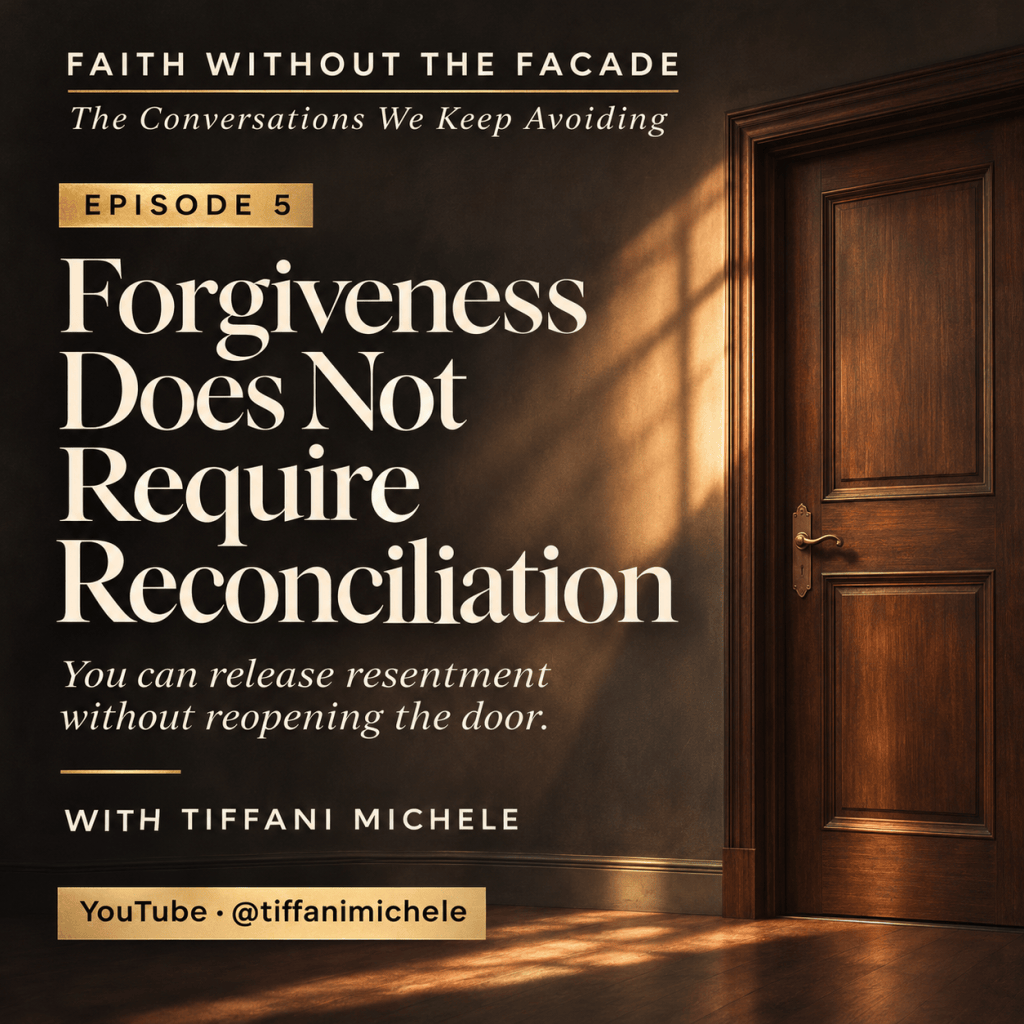
Can we have another uncomfortable conversation?
Because somewhere along the way, we’ve developed a troubling misconception about forgiveness.
We’ve convinced ourselves that forgiving someone means restoring the relationship.
That extending grace requires giving someone another opportunity to hurt us.
That choosing peace means pretending the damage never happened.
And perhaps most concerning, we’ve sometimes used faith to pressure people into relationships they no longer feel emotionally or physically safe maintaining.
But here’s something I want us to understand.
Forgiveness and reconciliation are not interchangeable.
You can forgive someone without restoring the relationship.
You can release resentment without pretending the offense was insignificant.
You can genuinely wish someone well while recognizing that their presence in your life is no longer healthy.
And you can choose to move forward without giving someone another opportunity to repeat the same harmful behavior.
Now, before someone interprets this as an argument against forgiveness, let me be clear.
I believe in forgiveness.
I believe in grace.
I believe in redemption, restoration, and the extraordinary possibility of personal transformation.
But I also believe in accountability.
I believe in healthy boundaries.
And I believe that genuine reconciliation requires more than an apology.
Welcome to Episode 5 of Faith Without the Facade: The Conversations We Keep Avoiding.
Let’s get into it.
The Difference Between Forgiveness and Reconciliation
One of the most important distinctions we can make is understanding what forgiveness and reconciliation actually involve.
Forgiveness is a personal and often gradual process of responding to an offense without allowing revenge or resentment to govern our choices.
It may involve releasing the desire to retaliate, acknowledging the pain we’ve experienced, and working toward emotional freedom.
Reconciliation, however, involves the restoration of a relationship.
And restoring a relationship generally requires participation from both people.
It requires honesty.
It requires accountability.
It requires the willingness to address what happened.
And when trust has been broken, it requires consistent behavior that demonstrates a commitment to change.
Those are not small requirements.
Consider a situation where someone repeatedly violates your trust.
They lie.
They make commitments they don’t honor.
They dismiss your concerns.
And when the relationship becomes strained, they apologize and expect everything to return to normal.
But what has actually changed?
Has the person acknowledged the specific behavior?
Have they demonstrated an understanding of the harm caused?
Have they taken meaningful steps to prevent the same pattern from continuing?
Or are they simply asking you to overlook the past so they can regain access to the relationship?
An apology may begin a conversation about reconciliation, but it does not automatically restore trust.
And forgiveness does not eliminate your right to make thoughtful decisions about the relationships you maintain.
Why We Confuse Forgiveness With Restoring Access
For many people, particularly within Christian communities, forgiveness has been presented as an obligation that must be demonstrated through immediate reconciliation.
We’re told to forgive and forget.
To turn the other cheek.
To extend grace.
To love unconditionally.
And while these teachings reflect important biblical principles, they can become harmful when interpreted without wisdom, context, and discernment.
Because love does not require us to ignore dangerous behavior.
Grace does not eliminate the need for accountability.
And forgiveness does not mean we must repeatedly expose ourselves to the same patterns of harm.
Proverbs 4:23 encourages us to guard our hearts with diligence.
That instruction reminds us that what we allow into our lives matters.
Our emotional well-being matters.
Our judgment matters.
And our responsibility to make wise decisions about relationships matters.
Healthy boundaries are not evidence that we’ve failed to forgive.
Sometimes they are evidence that we’ve learned to recognize what is necessary for our well-being.
Forgiveness Is Not Permission to Repeat the Offense
Now, let’s address another uncomfortable reality.
Some people are not primarily interested in reconciliation.
They’re interested in regaining access.
They want the relationship to return to normal.
They want the benefits of your presence, support, loyalty, or affection.
But they don’t necessarily want to confront the behavior that damaged the relationship in the first place.
They apologize without acknowledging the specific offense.
They minimize the impact of their actions.
They become frustrated when trust isn’t immediately restored.
And sometimes they use spiritual language to pressure the other person into moving forward.
“I thought you were supposed to forgive.”
“You’re not acting very Christian.”
“If you’ve really forgiven me, why are you still bringing this up?”
But here’s the truth.
Forgiveness is not a substitute for accountability.
And it is not a guarantee of renewed access.
If someone genuinely desires reconciliation, they must be willing to recognize that trust is rebuilt through consistent behavior over time.
They cannot demand immediate restoration simply because they’ve apologized.
They cannot dictate how quickly someone else should heal.
And they cannot use forgiveness as a way to avoid responsibility for the consequences of their decisions.
True reconciliation requires humility.
It requires patience.
And it requires accepting that the person who was hurt may ultimately choose not to restore the relationship.
What Scripture Teaches About Forgiveness and Peace
Ephesians 4:31–32 encourages believers to put away bitterness, anger, and malice while practicing kindness, compassion, and forgiveness.
That passage offers a powerful reminder about the importance of how we respond to offenses.
But it should not be interpreted as a requirement to ignore harmful behavior or abandon necessary boundaries.
Likewise, Romans 12:18 states:
“If it be possible, as much as lieth in you, live peaceably with all men.” — KJV
Notice the qualification.
If it be possible.
Scripture acknowledges that peace is not always achievable in every relationship.
We can take responsibility for our own conduct.
We can pursue honesty, compassion, and integrity.
We can choose not to retaliate.
But we cannot force another person to become accountable, trustworthy, or emotionally healthy.
And we cannot guarantee reconciliation through our efforts alone.
Sometimes the most responsible choice is to accept that a relationship cannot continue in its previous form.
That doesn’t automatically mean we’re holding on to bitterness.
It may mean we’re exercising discernment.
Peace is not always the restoration of a relationship. Sometimes it is the acceptance that a relationship has changed.
When Forgiveness Becomes a Process Rather Than a Moment
Another misconception about forgiveness is that it must happen immediately.
We sometimes expect people to experience a painful betrayal, make a conscious decision to forgive, and then move forward as though the emotional consequences have disappeared.
But human healing is rarely that simple.
Forgiveness may involve a process of acknowledging what happened, grieving what was lost, confronting difficult emotions, and gradually releasing the desire for retaliation.
Some people experience that process quickly.
Others require considerably more time.
And for individuals who have experienced serious betrayal, abuse, or trauma, healing may involve professional support and careful attention to emotional safety.
There is no universal timeline.
You cannot rush someone else’s healing simply because their pain makes you uncomfortable.
And if you’re the person who has been hurt, you don’t have to pretend you’ve reached a place of forgiveness before you genuinely have.
You can be committed to healing while acknowledging that you’re still working through difficult emotions.
You can choose not to retaliate while recognizing that sadness, anger, or disappointment remain.
And you can move toward emotional freedom without forcing yourself into premature reconciliation.
Forgiveness should not become another standard we use to shame people who are still healing.
The Difference Between Boundaries and Bitterness
Now, here’s where I want us to examine ourselves.
Because while boundaries can protect our well-being, we should also be willing to consider whether unresolved resentment is influencing our decisions.
A boundary says:
“I recognize that this relationship is not healthy for me, and I need distance.”
Bitterness may sound like:
“I want this person to suffer because of what they did.”
A boundary protects.
Bitterness can keep us emotionally invested in the desire for revenge.
But let’s be careful.
Feeling anger, grief, or sadness after being hurt does not automatically mean someone is bitter.
Those emotions can be natural responses to painful experiences.
And choosing not to reconcile is not, by itself, evidence of resentment.
The question is whether our decisions are being guided by wisdom and self-respect or by a continuing desire to punish someone.
You can establish a firm boundary without wishing harm on the person who violated your trust.
You can acknowledge that someone hurt you without allowing revenge to become your purpose.
And you can move forward with your life without needing the other person to validate your experience.
That is a meaningful form of emotional freedom.
Reconciliation Requires More Than an Apology
Let’s talk about what genuine reconciliation may require.
Because we’ve become very comfortable celebrating apologies without examining whether meaningful change follows.
A sincere apology can be important.
But rebuilding a relationship requires more.
It requires acknowledging what happened without minimizing the offense.
It requires accepting responsibility without immediately shifting blame.
It requires listening to how the behavior affected the other person.
And it requires developing new patterns that reduce the likelihood of repeating the same harm.
Sometimes reconciliation also requires counseling, mediation, or other forms of support.
And sometimes, despite sincere efforts, reconciliation is not possible.
That reality must be respected.
No one is entitled to restored trust simply because they’ve expressed regret.
Trust is developed through experience.
It is strengthened through consistency.
And when it has been broken, rebuilding it may take time.
The person seeking reconciliation must be willing to participate in that process without demanding a guaranteed outcome.
When Walking Away Is an Act of Wisdom
There are situations where maintaining distance is not simply a preference.
It may be necessary for safety, stability, or emotional well-being.
Relationships involving abuse, coercion, intimidation, repeated manipulation, or persistent boundary violations require particular care.
In those circumstances, the priority should be safety rather than pressure to reconcile.
No one should be encouraged to return to a dangerous relationship simply to demonstrate forgiveness or spiritual maturity.
And no one should be made to feel that protecting themselves represents a failure of faith.
Sometimes moving forward means accepting that the relationship cannot be restored.
Sometimes it means creating distance while continuing to work through the emotional impact.
And sometimes it means seeking support from trusted individuals or qualified professionals.
You can honor your faith while also honoring your responsibility to protect your well-being.
Those commitments do not have to compete.
The Mirror Moment: Five Questions About Forgiveness and Reconciliation
Before you begin identifying someone else who needs this message, I want you to reflect on your own experiences.
1. Have I confused forgiveness with restoring access?
Do I believe that forgiving someone automatically requires me to return to the relationship?
2. Am I asking someone to forgive me without demonstrating accountability?
Have I acknowledged the specific harm caused, or am I primarily focused on moving past the consequences?
3. Are my boundaries rooted in wisdom or a desire for retaliation?
Am I protecting my well-being, or am I hoping to punish someone through my decisions?
4. Have I given myself permission to heal without rushing the process?
Am I allowing myself to acknowledge difficult emotions while moving toward emotional freedom?
5. Can I accept that reconciliation may not be possible?
Am I willing to respect another person’s boundaries, even when I genuinely desire restoration?
These questions are not intended to create guilt.
They’re intended to encourage clarity, self-awareness, and emotional responsibility.
Five Practical Ways to Practice Forgiveness Without Abandoning Your Boundaries
1. Acknowledge the offense honestly.
Forgiveness does not require minimizing what happened. Give yourself permission to recognize the harm and its impact.
2. Separate forgiveness from decisions about access.
You can work toward releasing resentment while independently deciding whether continued contact is healthy or appropriate.
3. Evaluate patterns rather than promises.
When considering reconciliation, pay attention to consistent behavior, accountability, and demonstrated change rather than relying exclusively on apologies.
4. Communicate boundaries when safe and appropriate.
Clearly express what you are and are not willing to accept. In unsafe circumstances, prioritize protection rather than further engagement.
5. Give yourself permission to pursue healing without a guaranteed relationship outcome.
Your growth does not have to depend on someone else’s willingness to apologize, change, or participate in reconciliation.
These practices can help us approach forgiveness with greater compassion, discernment, and personal responsibility.
A Final Thought: You Can Release the Hurt Without Reopening the Door
I want to leave you with something I hope you’ll remember.
Forgiveness is not a declaration that what happened was acceptable.
It’s not permission for someone to repeat the same harmful behavior.
And it’s not a guarantee that the relationship will return to what it once was.
Forgiveness can be part of choosing not to let an offense govern the rest of your life.
But reconciliation requires something different.
It requires mutual willingness.
It requires honesty.
It requires accountability.
And it requires a foundation upon which trust can be rebuilt.
Sometimes that foundation can be restored.
Sometimes it cannot.
And sometimes the healthiest decision is to accept that a relationship has served its season in your life.
That doesn’t mean you have to hate the person.
It doesn’t mean you have to wish them harm.
And it doesn’t mean you’ve failed spiritually.
It may simply mean you’ve learned that compassion and discernment can coexist.
You can pray for someone without maintaining contact.
You can wish them well without inviting them back into your personal life.
You can acknowledge the good that once existed while accepting that the relationship is no longer healthy.
And you can move forward without requiring the other person to understand or agree with your decision.
Forgiveness does not require you to sacrifice your dignity, safety, or emotional well-being.
So before you allow someone to convince you that your boundaries demonstrate a lack of forgiveness, ask yourself whether they’re genuinely seeking reconciliation or simply expecting renewed access without accountability.
And before you demand another opportunity from someone you’ve hurt, ask whether you’ve demonstrated the humility and change necessary to rebuild what was broken.
Because forgiveness is a matter of grace. Reconciliation is a matter of mutual responsibility.
And both deserve to be approached with wisdom, compassion, and integrity.
With faith, purpose, and an unwavering commitment to growth,
Tiffani Michele
Faith Without the Facade: The Conversations We Keep Avoiding
Faith should do more than inspire us. IT SHOULD CHANGE US!
Watch Episode 5 on YouTube
Forgiveness Does Not Require Reconciliation
Join me for Episode 5 of Faith Without the Facade, scheduled for Saturday, November 21, 2026.
▶️ Watch and subscribe: Forgiveness Does Not Require Reconciliation!
This week’s conversation question:
Can you genuinely forgive someone while choosing not to restore the relationship? What does healthy forgiveness look like to you?
Share your thoughts in the YouTube comments. Let’s create space for honest reflection, meaningful dialogue, and personal transformation.
Connect with Tiffani Michele
Website: www.iamtiffanimichele.com
Instagram: @iamtiffanimichele
YouTube: https://www.youtube.com/@tiffanimichele
Email: iamtiffanimichele@gmail.com










































Leave a Reply